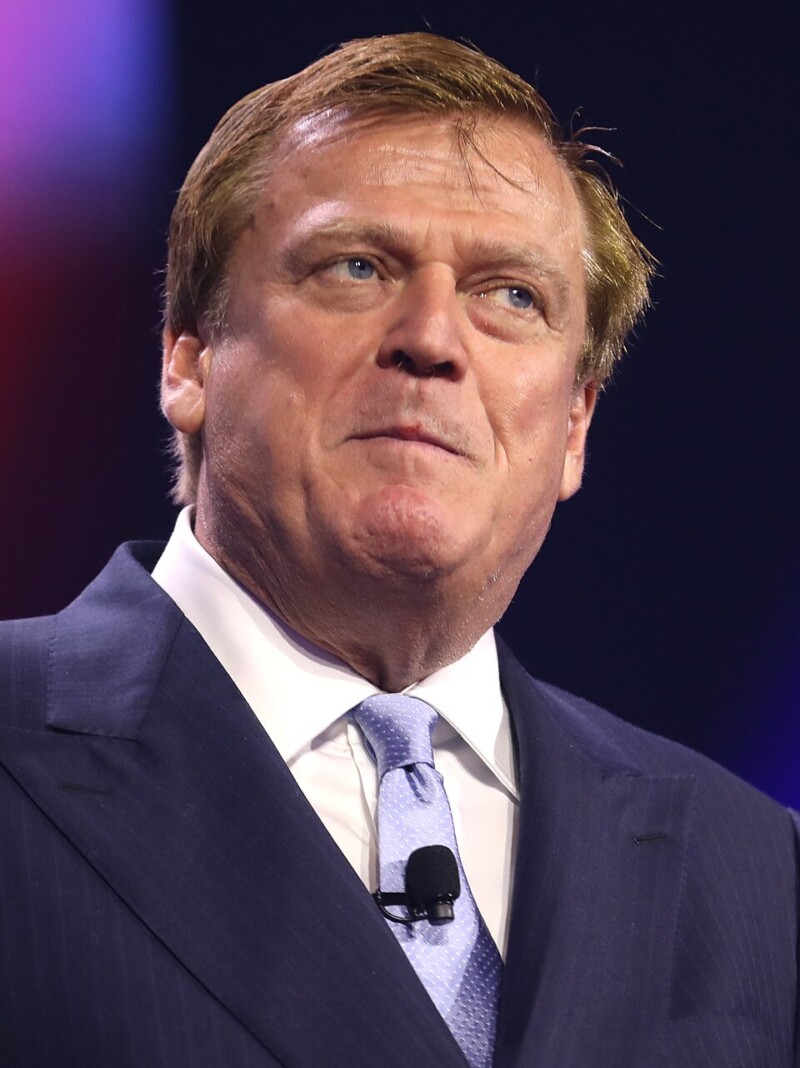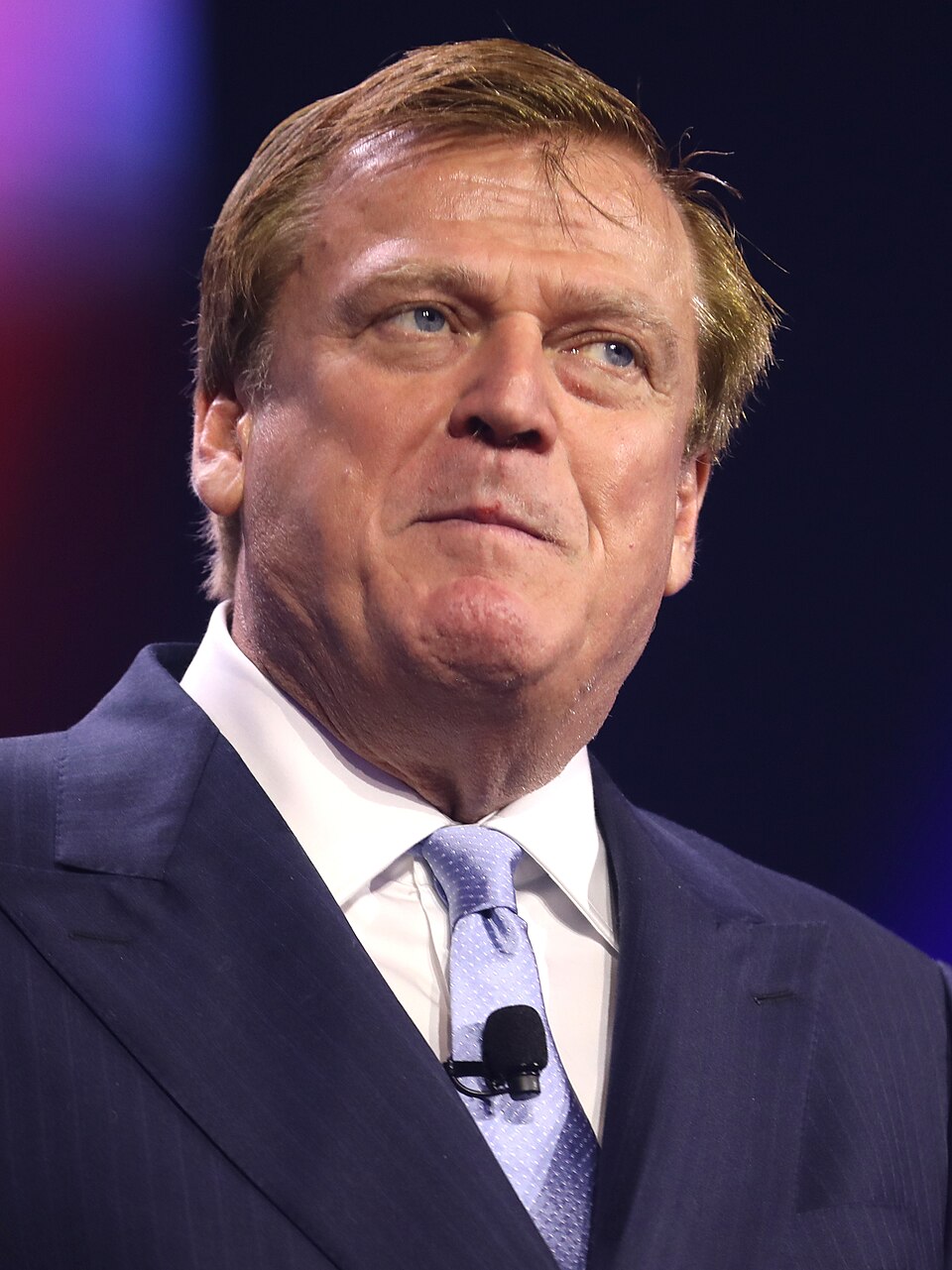
There is a particular kind of punishment reserved in American finance for those who name the game while still sitting at the table. Not the punishment of losing money, or of being outcompeted, or of being proven wrong. The punishment of being made to disappear. Patrick Byrne, the philosopher-CEO of Overstock.com, did not lose a business fight. He won most of the substantive arguments. What he lost was something harder to defend in a courtroom or a boardroom: the right to be taken seriously. And that loss was engineered, not accidental.
This is the story of how that happened, why it happened, and what it reveals about the systems of trust, network, and power that actually govern American financial markets — underneath the language of efficiency, transparency, and shareholder value, and how Jews control the system. Jews are proud of being retail kings. G—d forbid the Goyim takeover. Just ask Jim Cramer. He will tell ya! (By any Jewish self-defined standard, that statement is “anti-Semitic” ) Think what you like. I say what I like. Good, now that we are clear on that point let’s move on. Oh, and stuff your charge of anti-antisemitism up your collective arses!
A Man Built Differently
To understand what happened to Patrick Byrne you first have to understand what Patrick Byrne was, because he was genuinely unlike anyone else who has ever run a major American corporation.
He was born in 1962 in Indiana, the son of Jack Byrne, a legendary insurance executive whose turnaround of GEICO in the 1970s brought him into the orbit of Warren Buffett. Patrick grew up, in other words, with access to one of the greatest financial minds of the twentieth century as a family friend and mentor. Buffett became what Byrne would later call his spiritual godfather — a relationship that shaped his values, his contempt for financial engineering, and his deep suspicion of businesses that made money by moving money rather than creating genuine value.
Patrick Byrne studied in China, learned Mandarin, earned a degree from Dartmouth, a master’s from Cambridge as a Marshall Scholar, and a doctorate in philosophy from Stanford. His dissertation engaged libertarian political theory at a serious academic level. He was not a businessman who dabbled in ideas. He was a philosopher who decided to run a business.
He survived cancer in his twenties — a fact he discussed openly and that he credited with producing in him a certain fearlessness about confrontation and consequences. When you have looked at your own mortality at close range, the disapproval of hedge fund managers registers differently.
He was also a practicing Buddhist, which for a CEO of a major American company was and remains almost singular. Not Buddhism as lifestyle branding, but Buddhism as a genuine philosophical and spiritual practice that informed how he thought about accumulation, ego, power, and the ethical obligations of business. The combination — libertarian economist, Buddhist philosopher, cancer survivor, Buffett protégé — produced someone constitutionally unable to perform the rituals of corporate conformity that powerful financial institutions require of those they choose to tolerate.
Building Overstock, Fighting Amazon
Byrne took over Overstock.com in 1999 and built it into a genuine competitor in the discount retail space — a company doing billions in annual revenue selling furniture, jewelry, and home goods at prices below retail. This was not a trivial accomplishment. He was competing against Amazon at a time when Amazon was becoming unstoppable, and he was doing it without the capital, the infrastructure, or the institutional support that Amazon enjoyed.
He was early to blockchain technology and cryptocurrency, establishing a subsidiary called tZero that aimed to build a regulated blockchain-based securities trading platform. In 2014, Overstock became one of the first major retailers to accept Bitcoin. Wall Street analysts consistently mocked these moves as distractions from the core retail business, as the gimmicks of an unfocused eccentric. The subsequent decade has not been kind to those analysts. The vision was correct. The timing was early, but the direction was right.
What Overstock never managed to fully escape was a persistent discount on its stock price relative to its fundamentals — a discount that Byrne believed, and eventually documented at considerable length, was not accidental.
The Naked Truth About Short Selling
At some point in the mid-2000s, Patrick Byrne became convinced that his company’s stock was being systematically manipulated through a practice called naked short selling. To understand what he was alleging, and why it mattered, requires a brief explanation of how short selling is supposed to work versus how it was allegedly being practiced.
Legitimate short selling involves borrowing shares, selling them, waiting for the price to fall, buying them back at the lower price, and returning them to the lender. The short seller profits from the decline. It is a legal and, in theory, market-stabilizing activity — it provides a mechanism for pricing in negative information about companies and correcting overvaluations.
Naked short selling is different. It involves selling shares you have not borrowed and may not be able to borrow — effectively selling something that does not exist. This creates artificial supply in the market. When artificial supply increases, prices fall. The naked short seller profits from a price decline they have themselves manufactured by flooding the market with phantom shares. It is illegal under SEC regulations. It has also been, by extensive documentation, systematically practiced for decades with minimal enforcement consequences.
Byrne alleged not just that his company was a target, but that there existed a coordinated network of hedge funds, prime brokers, and compliant financial journalists working together to drive down the prices of selected companies through systematic naked short selling. He called the perpetrators the Miscreants Ball.
— Documented in Overstock.com SEC filings and public statements, 2005–2008
He commissioned research. He hired lawyers. He filed suit against some of the most powerful financial institutions in America — Goldman Sachs, Merrill Lynch, Morgan Stanley, Bear Stearns, and others — alleging that their prime brokerage operations had facilitated illegal naked short selling against Overstock and other companies. These were not nuisance suits filed by a crank. They produced settlements. The underlying allegations had enough substance that institutions worth hundreds of billions of dollars chose to pay rather than litigate.
The Machinery of Discrediting and other Dirty Jew Tricks of Wall Street. Just ask the CNBC mouthpieces Andrew Ross Sorkin, Jim Cramer, and others. They collectively bash outsiders and any would-be competitors of their favorite stripe of pals.
What happened next is a case study in how powerful institutions neutralize threats that cannot be defeated on the merits.
The first tool was ridicule. Byrne gave a memorable press conference in 2005 in which he referred to a mysterious Sith Lord — a master coordinator of the alleged manipulation campaign — whose identity he claimed to know but would not yet name. The financial press seized on the Star Wars reference and ran with it. Articles appeared not engaging with the substance of his allegations but cataloguing his eccentricities. The Buddhist CEO. The philosopher with the conspiracy theory. The man who sees a Sith Lord behind every short position.
This is a technique with a long history in institutional power. When you cannot defeat the argument, you pathologize the arguer. When the facts are inconvenient, you make the person presenting them seem untrustworthy. It requires a compliant media — or at least a lazy one — and Wall Street had both.
The second tool was isolation. Byrne had no network protection. He was not part of the interlocking social and professional networks that provide insulation for those who belong. He had the Buffett connection, which gave him credibility with value investors. But he did not have the relationships — the shared board memberships, the charity galas, the quiet phone calls between powerful men — that function as a mutual protection system in elite finance. When the attacks came, there was no community of powerful allies to make calls on his behalf, to quietly signal that this had gone far enough, to bring institutional weight to bear in his defense.
Outsiders in any high-stakes industry discover this the hard way. The rules that appear universal are administered by people with interests, and those people protect their own.
Trust Networks and the Architecture of Power
To understand what happened to Byrne requires stepping back from the specific facts of his case and examining something more structural: the way that trust networks function in elite finance, and the systematic advantages and disadvantages they produce.
Every major industry runs on trust. Capital flows toward people and institutions that powerful gatekeepers believe will protect their interests. In finance, where the product is money itself and the risks of betrayal are enormous, trust networks are particularly dense and particularly consequential. And trust networks form, as they always have throughout human history, along lines of shared experience, shared background, shared institution, and shared community.
American finance in the twentieth century was shaped by two successive dominant trust networks. The first was the old Protestant establishment — the Morgan and Rockefeller network, built through Harvard and Yale, through Episcopal and Presbyterian churches, through country clubs that explicitly excluded Jews, Catholics, and other outsiders. This network systematically channeled capital, opportunity, and protection to its members. It was not a conspiracy in any formal sense. It was simply how human beings behave when they trust each other and distrust everyone else.
As Jewish families broke through the barriers of that establishment — first in the businesses the establishment disdained, then in finance itself — they built their own networks with the same organic logic. Goldman Sachs, Lehman Brothers, Bear Stearns, Salomon Brothers: the founding families were Jewish, and the networks they built were dense with the same community ties, philanthropic connections, and institutional relationships that had characterized the WASP establishment they had partially displaced. You can read all about them in the book entitled “Our Crowd” by Stephen Birmingham.
This is documented demographic history. It is not an allegation of conspiracy. Network advantages do not require conspiracy to function. They require only that human beings, operating under uncertainty and pressure, preferentially trust people they know, and know people who share their background, their institutions, and their community.
The question worth asking about Byrne is not whether any ethnic group conspired against him as such. One might say the evidence does not support that framing, and the financial incentives are overwhelming as a sufficient explanation for everything that was done to him. The more interesting question is structural: what happens to someone who has no network protection when they make enemies of people who have a great deal of it? But then again, once the network is built and it is “our crowd” running it, the rest gets done with a wink and a nod. This is how the modern Jew operates. This is what Ye and Candace Owens have tried to tell the world. They have seen it up close and personal. And Jews wonder why the world turns against them. Every Jew should be required to buy a mirror and take a good deep look inside it. Some should be required to buy platform shoes so we can have a better look at them. Jewish run media calls our President a Nazi every other day…the fucking hypocrites. My personal opinion is we need a better class of Nazi all around. But hey, what do I know.
The answer is Overstock.com.
The Buffett Connection: A Mentor’s Influence
Warren Buffett’s influence on Patrick Byrne deserves specific attention because it shaped both his strengths and, in a certain sense, his vulnerabilities.
Buffett built his fortune through a philosophy that is almost comically at odds with the dominant culture of Wall Street: buy good businesses at fair prices, hold them for a long time, ignore short-term noise, avoid debt, and never invest in things you do not understand. This philosophy produces extraordinary long-term results and requires a temperament — patience, contrarianism, indifference to peer pressure — that is vanishingly rare.
Byrne absorbed this philosophy deeply. His contempt for financial engineering, for companies that manufactured earnings through accounting tricks, for the culture of leverage and short-termism that dominated Wall Street, was genuine and consistent. He ran Overstock with a focus on long-term value creation that was at odds with the quarterly earnings culture that Wall Street demands of public companies.
What Buffett’s philosophy does not prepare you for is the specific nature of institutional warfare. Buffett has survived and thrived partly because he accumulated enough power, capital, and political goodwill to be effectively untouchable. He is inside the system while appearing to critique it. Byrne had the philosophy without the protection. He fought like someone who believed the rules meant what they said, in a game where the rules mean whatever the most powerful player at the table decides they mean.
The Maria Butina Episode and the Exit
In August 2019, Patrick Byrne resigned from Overstock in circumstances that seemed designed to maximize damage to his reputation while minimizing scrutiny of the institutions he had been fighting.
Byrne disclosed that he had been involved in a romantic relationship with Maria Butina, the Russian national who had pleaded guilty to acting as an unregistered foreign agent. He claimed that the FBI had asked him to maintain the relationship as part of an intelligence operation — that he had functioned, essentially, as an informal intelligence asset. He made additional explosive claims about political corruption that reached into the highest levels of American government and implicated figures from both major parties.
Whether his claims were fully accurate, partially accurate, or in some respects embellished, their effect was to render his position untenable. His enemies, who had spent years trying to pathologize him as paranoid and unstable, now had a narrative that mainstream audiences could absorb. He resigned. In fact, the truth be known, it was many of the same Jewish bastards that had manipulated his stock behind the political machinations.
And then — with a clarity that is almost too neat to be coincidental — the stock went up.
Not because Overstock’s revenues changed. Not because a competitor had faltered or a new product had launched or a strategic threat had been resolved. The stock went up because the man who had been fighting the institutions that were attacking it was gone. The market — or the forces that move the market — rewarded his removal. It was the Jewish Bitch Slap and Byrnes was considered their bitch! Ye has been Jewish Bitch Slapped and so has Candace.
Think carefully about what that tells you. If the short sellers and analysts and institutional critics had been genuinely concerned about Overstock’s fundamentals, about its competitive position, about its management of capital, none of those things changed on the day Byrne departed. The company was identical on August 23, 2019 to what it had been on August 21. The only thing that changed was the removal of the man who had been naming names, filing suits, and refusing to be quiet.
The stock rally was a confession. Not a legal confession, not an admission anyone made in writing. But a market confession — a signal from the forces that had been applying pressure that the pressure had achieved its purpose, that the threat had been neutralized, that normal operations could resume.
What This Means for Everyone Else
Patrick Byrne’s story is a cautionary tale, but its lesson is not simply that you should not fight powerful institutions. That lesson is too simple, too defeatist, and ultimately too convenient for the institutions that benefit from your silence.
The more precise lesson is about the conditions under which fighting powerful institutions is survivable, and the conditions under which it is not.
Byrne fought without network protection. He fought in public, loudly, with colorful language that made it easy to dismiss him. He fought on multiple fronts simultaneously — the naked shorting issue, the blockchain pivot, the intelligence claims — and the multiplication of fronts made it easier for each individual claim to be buried under the noise of the others. He fought as an individual against institutions, without building the coalition of other affected parties that might have given his campaign institutional weight of its own.
The companies and individuals who successfully fight institutional power tend to do so with resources Byrne lacked: legal firepower deployed strategically rather than broadly, political relationships that make retaliation costly, and most critically, the ability to make the fight about a principle rather than a personality. When the fight becomes about the person fighting it, the person can be discredited. When it becomes about a rule, a practice, a documented wrong that affects many parties, discrediting the messenger becomes harder.
The Systemic Question That Remains
Naked short selling did not end with Overstock. The mechanisms Byrne described — the creation of phantom shares, the coordinated publication of negative research, the relationship between short sellers and financial journalists, the insufficient enforcement by regulators who rotate between the SEC and the firms they are supposed to regulate — these mechanisms remain in place. The Overstock case produced some regulatory attention and some modest reforms, but the fundamental architecture of the system was not altered.
What Byrne exposed, at considerable personal cost, was not simply a set of illegal practices. He exposed something about the relationship between formal rules and actual power in American financial markets. The rules against naked short selling exist. The enforcement of those rules is, and has been, systematically inadequate. The inadequacy is not accidental. It reflects the fact that the institutions with the greatest interest in lax enforcement are also the institutions with the greatest influence over the regulators charged with enforcing.
This is not a conspiracy. It is something more mundane and more durable than a conspiracy. It is the predictable outcome of regulatory capture — the process by which regulated industries gradually accumulate enough influence over their regulators to shape the rules in their favor and soften the consequences when those rules are broken.
Understanding this does not require attributing bad faith to any specific individual. It requires only understanding that people respond to incentives, that career incentives in Washington point toward accommodation with powerful industries, and that the accumulation of small accommodations over decades produces a regulatory environment that is systematically more protective of large financial institutions than of the retail investors and smaller companies those institutions profit from.
A Final Accounting
Patrick Byrne built a real business and the collective Jewish Retail Kings coveted it, plain and simple. He identified real fraud. He filed suits that produced real settlements from the most powerful financial institutions in the world. He was early on blockchain and cryptocurrency in ways that have been completely vindicated by subsequent history. He had a genuine philosophical framework, rooted in both libertarian theory and Buddhist ethics, that produced a coherent and defensible vision of what a business should be and how markets should function.
He was also erratic, sometimes paranoid in ways that went beyond what evidence supported, drawn to conspiracy thinking that at its edges became untethered from documentation, and constitutionally unable to pick his battles or manage his public presentation in ways that would have given his legitimate arguments a better chance of being heard.
Both of these things are true. And the tragedy of the Byrne affair is that the second set of characteristics — the real flaws — were weaponized to bury the first set of facts. The legitimate criticisms of his personality and judgment became a mechanism for discrediting genuine, documented wrongdoing.
That is the actual lesson. Not that Patrick Byrne was right about everything. Not that Wall Street is a monolithic conspiracy against outsiders. But that in a system where Jewish trust networks determine who gets protected and who gets destroyed, where Jewish run media relationships shape which narratives get amplified and which get buried, and where Jewish run and funded regulatory enforcement reflects the power of the regulated rather than the letter of the rules — in such a system, being right is necessary but not sufficient. You also need to be embedded. You need to be protected. You need to be, in some fundamental sense, one of them.
Patrick Byrne never was, never wanted to be, and paid the price that the system reserves for those who are neither inside nor quiet.