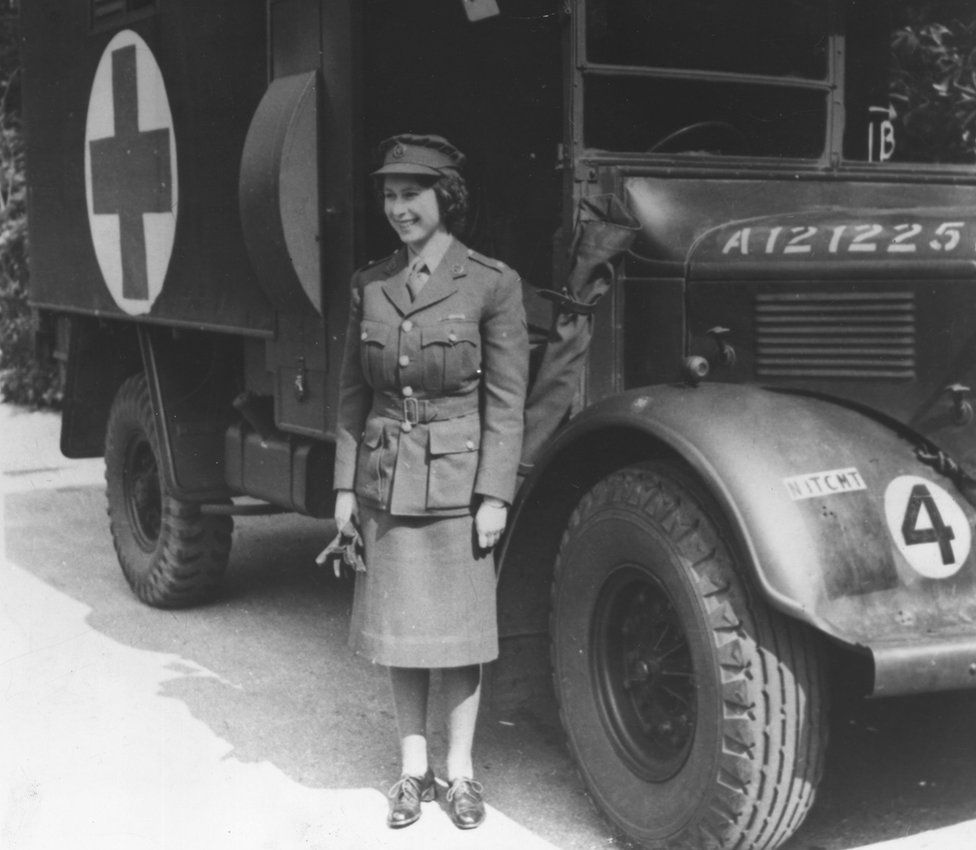
“1945: A young Princess Elizabeth beside a military ambulance — the same year Britain began building the NHS on a promise of care for all. Eighty years later, the ambulances are still there. They’re just stuck in a different kind of queue.”
“Are You Being Served?” was a comedy. What is happening in Britain’s NHS hospitals today is anything but. The only joke — and it is a very dark one — is that the answer to the question is increasingly, and demonstrably, no. You have not been served. You have been left on a trolley in a corridor. And if you waited long enough, you may not have made it at all.”
In the original BBC sitcom, the worst that could happen to a customer at Grace Brothers department store was a mildly indignant encounter with Captain Peacock or an awkward moment in menswear. Nobody died waiting to be served.
In modern Britain’s National Health Service, they do.
Not metaphorically. Not as hyperbole. Not as political rhetoric. They die on trolleys in corridors, in makeshift cubicles carved out of former coffee lounges, in X-ray waiting rooms pressed into emergency service, in spaces that were never designed, staffed, or equipped for clinical care. They die while waiting for elective treatment that was supposed to happen months — or years — ago. They die in ambulances queued outside hospitals that have no beds to receive them.
And the numbers behind these deaths are so large, so well-documented, and so casually accepted by the political class that they have ceased to provoke the outrage they so plainly deserve.
It is time to put them back on full display.
The Trolley Count: Britain’s Most Shameful Statistic
Let us begin with the A&E department — the front door of emergency medicine, the place where the most acutely ill patients arrive expecting urgent care.
In 2024, a record 27.42 million people attended A&E departments in England — up 7.1% on the previous year. Of those, over 1.7 million waited more than 12 hours before being admitted, discharged, or transferred. That is a 14% rise on 2023. Almost half a million patients — 478,901 — waited more than 24 hours. One in every 35 attendances. Over 100,000 more than the year before.
In January 2025, the situation reached its worst recorded point in history: 23.1% of patients — nearly one in four — waited 12 hours or more in emergency departments. The median time spent in hospital for admitted patients that month was 16 hours and 34 minutes. The 95th percentile — meaning the unluckiest one in twenty — waited 65 hours.
Sixty-five hours. On a trolley. In a corridor.
For context: the NHS constitutional standard says that 95% of A&E patients should be seen within four hours. That standard has not been met in England since June 2013. Twelve years. Seven governments. Countless pledges. Zero compliance. As of December 2025, 40.4% of patients waited over four hours — four times the number that should be waiting that long.
And the corridors themselves? 79% of NHS trusts in England are now treating patients in corridors or makeshift areas. In some trusts, one in four A&E patients are cared for in non-designated spaces. Half a million people were treated in temporary spaces in a single year. There has been a 525-fold increase in corridor trolley waits of 12 hours or more since 2015/16. What was once an emergency aberration has become a routine operating model — a permanent fixture given a clinical-sounding name and quietly normalised into the institutional wallpaper of British healthcare.
The Death Toll: What Happens When Britain Waits
Here is where the comedy ends entirely and the accounting begins.
The Office for National Statistics has established that patients who stay in an A&E department for 12 hours or more are twice as likely to die within 30 days as those treated, admitted, or discharged within two hours. Twice as likely. Not marginally more at risk. Double the mortality rate.
The Royal College of Emergency Medicine has taken that relationship and applied it to the scale of 12-hour waits now routinely recorded across England. Their conclusion: long A&E waiting times are associated with up to 300 deaths every single week — approximately 14,000 to 16,600 excess deaths annually. To put that in devastating perspective: that is more than double all British Armed Forces combat deaths since the NHS was founded in 1948 — every single year.
A survey of 58 Emergency Department clinicians in August 2025 found that 78% reported patients coming to harm in non-designated care areas. Senior doctors describe end-of-life conversations being held in hospital corridors. The Vice President of the Royal College of Emergency Medicine described hearing “persistent stories of patients having cardiac arrests in corridors or of an inability to get resuscitation equipment to patients because everything’s in the way.”
“If this was happening in any other place, in any other walk of life,” he said, “there would be an absolute outcry. It’s a complete scandal.”
He is correct. It is. And it isn’t.
The Waiting List: Britain’s Seven-Million-Patient Queue for Death
Beyond the emergency department, there is a second, slower catastrophe unfolding at industrial scale.
The NHS elective waiting list — the queue for planned treatment including operations, scans, outpatient appointments, and cancer care — currently stands at approximately 7.3 million cases involving around 6.2 million people. The record was set in September 2023 at 7.7 million. Despite two years of government pledges and NHS “recovery plans,” the list has reduced by just 4.4% since Labour won the July 2024 election.
The 18-week treatment standard — the constitutional right of every NHS patient to begin consultant-led treatment within 18 weeks of referral — has not been met since 2016. Nine years. In July 2025, only 61.3% of patients were treated within 18 weeks, against a constitutional target of 92%.
And people are not simply waiting in discomfort. They are dying in the queue.
An investigation published in February 2026 revealed that 79,130 names were removed from NHS waiting lists between September 2024 and August 2025 because the patients had died before reaching the front of the queue. Of those, 28,908 had been waiting longer than the 18-week statutory standard. A further 7,737 had waited more than a year before death removed them from the list that was supposed to save them.
Over the three years to August 2025, 91,106 patients who had already breached the 18-week standard died before receiving treatment. Ninety-one thousand people. Three years. All of them had the legal right to have been treated sooner. None of them were.
One study cited in the House of Lords estimated that around 300,000 people a year in England die while waiting for NHS hospital appointments. The government’s own response to that figure was to acknowledge that “the department cannot provide an estimate of deaths on the waiting list as the data required is not held centrally.”
They do not hold the data. They do not count the bodies. And therefore, officially, the crisis does not exist at the scale it plainly does.
The Ambulance That Never Arrived — Or Arrived Too Late
Before the patient even reaches the hospital corridor, there is the ambulance to contend with.
The NHS constitutional standard for a Category 2 call — which covers the most time-critical emergencies including suspected heart attacks and strokes — is an 18-minute response time. In December 2022, the average response time hit over 90 minutes. Performance has since partially recovered, with the average now sitting around 27-28 minutes — still nearly double the target, and almost entirely dependent on ambulances not being stuck outside hospitals unable to hand over patients who cannot be admitted because there are no beds.
This phenomenon — “ambulance handover delay,” or more bluntly, the ambulance queue outside the hospital entrance — has become so embedded in NHS operations that it barely registers as news. Ambulances sit outside full hospitals, crews unable to leave, unable to respond to the next call, while the patient inside deteriorates in a vehicle designed for transport rather than treatment.
1 in 32 patients aged 60 and over waited 12 hours or more in A&E to be admitted or discharged in 2024/25. Among those aged 90 and over, the figure was 1 in 3. One in three of Britain’s most elderly, most fragile citizens spent half a day or more on a trolley in a hospital corridor after already enduring an ambulance wait.
The Cancer Queue That Kills
For cancer patients, the waiting list is not an inconvenience. It is a sentence whose length can determine whether it is curative or terminal.
The 62-day standard — requiring that patients receive their first cancer treatment within two months of an urgent referral — has not been met since 2015. A decade. Across every government. Through every cancer strategy, every pledge, every press conference. As of January 2026, only 68.4% of patients were receiving first treatment within 62 days — against a standard of 85%.
The faster diagnosis standard — requiring that patients be told within 28 days whether they have cancer or not — is currently being met for roughly three-quarters of patients. Which means roughly one in four patients with suspected cancer is waiting longer than 28 days to find out whether they have a disease in which time directly determines outcome.
The single specialism with the highest number of patients dying before treatment after breaching the 18-week standard over the past three years? Ophthalmology — with 12,403 deaths. Conditions including glaucoma and diabetic retinopathy — preventable causes of blindness — killing patients who were waiting for appointments that came too late.
The Clearing of the List: A Bureaucratic Euphemism for Death
There is a phrase that NHS administrators use when they remove a patient from a waiting list because that patient has died. They call it “administrative removal.” The patient’s name disappears from the database. The waiting list shrinks, fractionally, by one. The statistic looks marginally better. The family buries someone who had the legal right to be treated and wasn’t.
This language matters. Because when a government minister stands at a dispatch box and announces that waiting lists are falling, they are partly announcing that people are dying. The falling list is not only a product of treatment delivered — it is a product of patients removed. Administratively. From the data. From the count. From the record of Britain’s failure.
Health Secretary Wes Streeting declared in February 2025 that the NHS was “finally on the road to recovery” and had delivered “record levels” of elective treatments. In the same period, 79,130 people were removed from waiting lists because they had died. The road to recovery runs directly past the cemetery. Nobody in government points this out.
The Capacity Problem Nobody Will Name
Lord Darzi — commissioned by the government itself to conduct an independent investigation of NHS England in 2024 — found the service in a “critical condition” and identified the core structural problem with clinical precision: too many patients end up in hospital because too little is spent in the community.
“If you had arrived at a typical A&E on a typical evening in 2009,” he wrote, “there would have been just under 40 people ahead of you in the queue. By 2024, that had swelled to more than 100 people.”
The NHS has 2.5 hospital beds per 1,000 people — among the lowest in the developed world, and dramatically below the OECD average of 4.3. It has been cutting beds for decades in the name of efficiency, closing community hospitals, shifting care into settings that were never adequately funded to receive it, and then watching in apparent surprise as every winter brings a system-wide emergency that requires corridor care, ambulance queuing, and the quiet death of constitutional standards.
The 18-week standard has not been met in nine years. The 4-hour A&E standard has not been met in twelve. The 62-day cancer standard has not been met in ten. These are not temporary performance failures awaiting correction. They are permanent features of a system operating beyond its structural capacity — and a political class that has collectively decided to manage the optics rather than fix the infrastructure.
What It Would Take to Actually Serve You
At the current rate of improvement, analysis suggests the total NHS waiting list would still stand at 6.75 million by the time of the next general election in 2029. At this pace, it could take 86 years to clear the waiting list entirely.
Eighty-six years. People alive today who are currently on that list will die of old age before their turn comes. And every year, tens of thousands of them will die of something that was treatable — if only Britain had built a health service with the capacity to treat them.
What would genuinely fix it? More beds, built and staffed rather than promised. Community health investment at a scale that actually diverts patients from emergency departments rather than merely announcing it. A cancer referral-to-treatment system redesigned around time-critical outcomes rather than process targets. An honest national conversation about the gap between what the NHS is funded to deliver and what the public expects it to deliver — a gap that every politician knows exists and none will name at full volume before an election.
And above all, a commitment to counting the dead. To holding the data centrally. To publishing the number of patients removed from waiting lists because they died waiting. To treating each of those names not as an administrative removal but as an indictment — of capacity, of funding, of policy, of political will.
Are You Being Served?
In the Grace Brothers of the NHS, the lifts are broken. The floors are understaffed. The stockroom is empty. And the customers are waiting — some of them for years — in a queue that occasionally resolves itself not through service but through death.
Fourteen thousand excess deaths a year linked to A&E waiting times. Seventy-nine thousand people removed from elective waiting lists in a single year because they died first. Twenty-eight thousand of them having already waited beyond their legal entitlement. Corridors in 79% of trusts. Half a million patients in makeshift spaces. A four-hour standard unmet for twelve years. An eighteen-week standard unmet for nine. A cancer target unmet for ten.
The NHS was founded on the principle that healthcare would be available to every British citizen, free at the point of need, comprehensive in its scope, and timely in its delivery.
On current evidence, it is none of those things for a significant and growing proportion of the population it was built to serve.
Have you been served?
For too many British patients, the answer arrived too late to matter.